
Easter Evidences: The Empty Tomb
The first and most undeniable sign of the resurrection

10 It was Mary Magdalene, Joanna, Mary the mother of James, and several other women who told the apostles what had happened. 11 But the story sounded like nonsense to the men, so they didn’t believe it. 12 However, Peter jumped up and ran to the tomb to look. Stooping, he peered in and saw the empty linen wrappings; then he went home again, wondering what had happened.
Luke 24:10-12 (NLT)
On the Sunday morning following His crucifixion, a group of Jesus’ women followers found His tomb empty.
On the Friday before, Jesus was crucified on a Roman cross by order of Pontius Pilate. This is probably the most well-attested fact that we have about Jesus Christ; if there’s anything we can say with confidence historically, it’s that Jesus died on a Roman cross.
And yet—the empty tomb has to be explained.
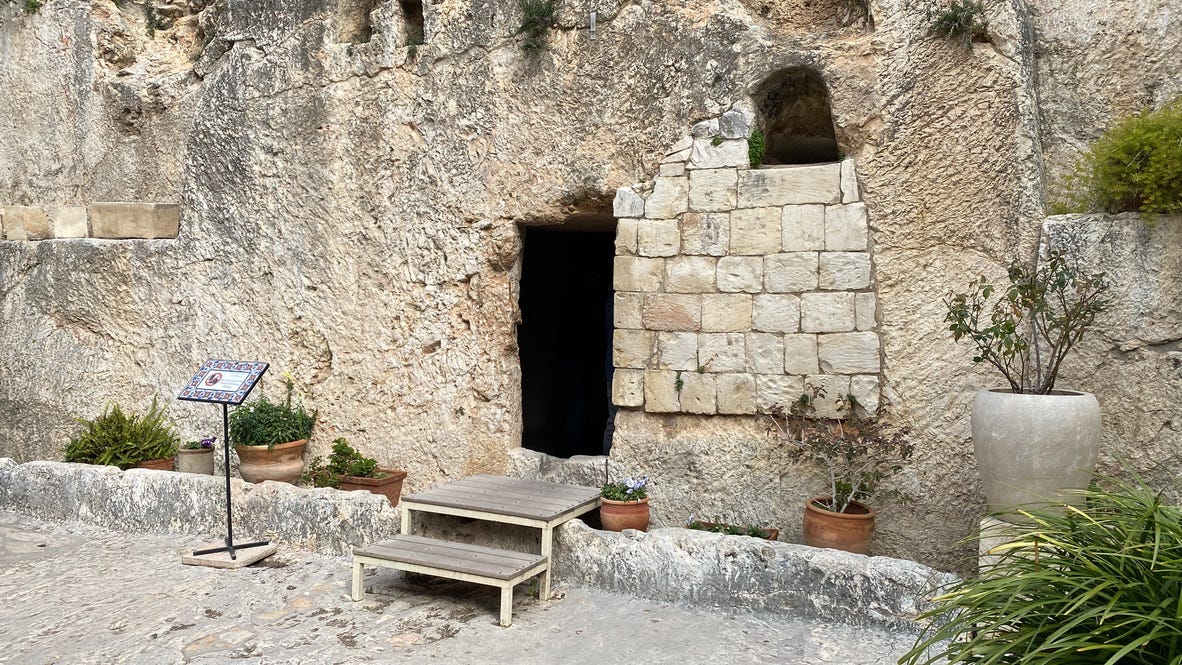
According to the Gospel authors, the stone was rolled away, and all that remained in the tomb were the linen-cloths He was wrapped in.
Interestingly, the first witnesses to the resurrection were women (Luke 24:10-12).
In this time and culture, women had low legal and social credibility.
If this event were fabricated, this detail would certainly not have been included. Yet every one of the Gospel authors insist on it.
The Disciples are not listed as heroes, but are portrayed in an almost embarrassing fashion, realizing after the women do what has truly taken place. This actually strengthens the historical credibility of the account.
The Gospels don’t read like legends—they read like history.
We see this account in all four gospels. The empty tomb validates Jesus’ claims—both His divine identity, and His prediction that He would be killed and raised to life again.
When we consider the timeline of events, it’s really remarkable how fast everything unfolded:
Thursday night was the Last Supper and arrest of Jesus in the Garden of Gethsemane.
Overnight was the trial and questioning by a kangaroo court of the religious leaders.
By Friday afternoon, Jesus was hanging on a cross.
He was buried quickly due to Shabbat laws, and after remaining home in deep grief on Saturday, the women followers came as early as possible that Sunday morning to finish the burial process for their Lord who had perished.
Yet on Sunday morning, the tomb was found empty!
The empty tomb is not just something to examine—it’s something to respond to.
It confronts us with a question:
What do we do with a risen Savior?
The same Jesus who invited Thomas to touch His wounds invites us to move from doubt to belief:
Then he said to Thomas, “Put your finger here, and look at my hands. Put your hand into the wound in my side. Don’t be faithless any longer. Believe!”
—Jesus, John 20:27 (NLT)
Prayer Spark:
Lord Jesus, we praise you because the tomb is empty! Thank you for your faithfulness even when we are faithless. Thank you for your willingness to endure the cross for our sakes. Thank you that you allow everyone—men and women alike—to come and discover the truth of your life and your love.
Lord, we acknowledge that the hope we have is based on your resurrection from the dead.
Thank you that when we waver, we can simply look at the empty tomb.
Bestow upon us your divine life. Thank you that you are not stuck in a sepulcher. Just as your love could not be bound by the grave, strengthen us according to your love. Empower us to live in faith, freedom, and fellowship with you.
Allow us to share this hope with exuberance and joy, in fullness and purpose, just as you did as you went to the cross.
In the name of Jesus we pray, amen!
Explore Further:
The Empty Tomb Accounts
The Burial & Description of the Tomb
Jesus Predicted His Resurrection
The Disciples Understood Afterwards
The Meaning of the Resurrection
The Resurrection Confirms Who Jesus Is
Easter Evidences
A 6-Day Journey Through the Evidence for Jesus’ Resurrection
More Than Blind Faith
The Empty Tomb
Seen Alive
From Fear to Faith
Not a Legend
Living the Resurrection